Table of Contents
I’ve been traveling with GaN chargers since they first hit the market, and I’ve seen my share of overpromised specs and disappointing real-world performance. When the MINIX S70 arrived on my desk, I was skeptical—another 70W charger claiming to revolutionize travel charging. But after three months of testing across international flights, hotel rooms, and coffee shop work sessions, this compact brick surprised me in ways most chargers don’t.
The real question isn’t whether the MINIX S70 can deliver 70 watts—any decent GaN charger can do that. The real value lies in how it manages that power across your devices, handles the rigors of travel, and solves the specific pain points of people who genuinely need reliable power on the go.
Key Takeaways
- Power distribution is smarter than most competitors—the 45W+20W dynamic allocation actually works in practice, not just on paper
- The compact design comes with a trade-off—it’s slightly thicker than some ultra-slim options but more stable in wall outlets
- Protocol compatibility is genuinely comprehensive—unlike some chargers that claim universal support but deliver inconsistent performance
- Build quality exceeds expectations for the price point—this doesn’t feel like a budget charger despite its competitive pricing
- Thermal management is where it truly separates from cheaper alternatives—maintaining full power output without throttling during extended use
Quick Verdict
Best for: Frequent travelers needing reliable laptop+phone charging, tech enthusiasts with multiple devices, professionals who work from multiple locations
Not ideal for: Users who only charge one device at a time, those needing ultra-slim profile above all else, people who primarily use USB-A devices
Core strengths: Intelligent power distribution that actually works in practice, excellent build quality for the price, comprehensive protocol support without compatibility issues, reliable thermal performance during extended use
Core weaknesses: Slightly thicker than some competing 65W options, no built-in cable management, the matte finish shows fingerprints more than expected
Product Overview & Specifications
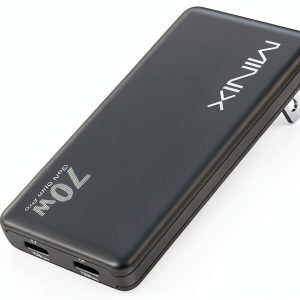
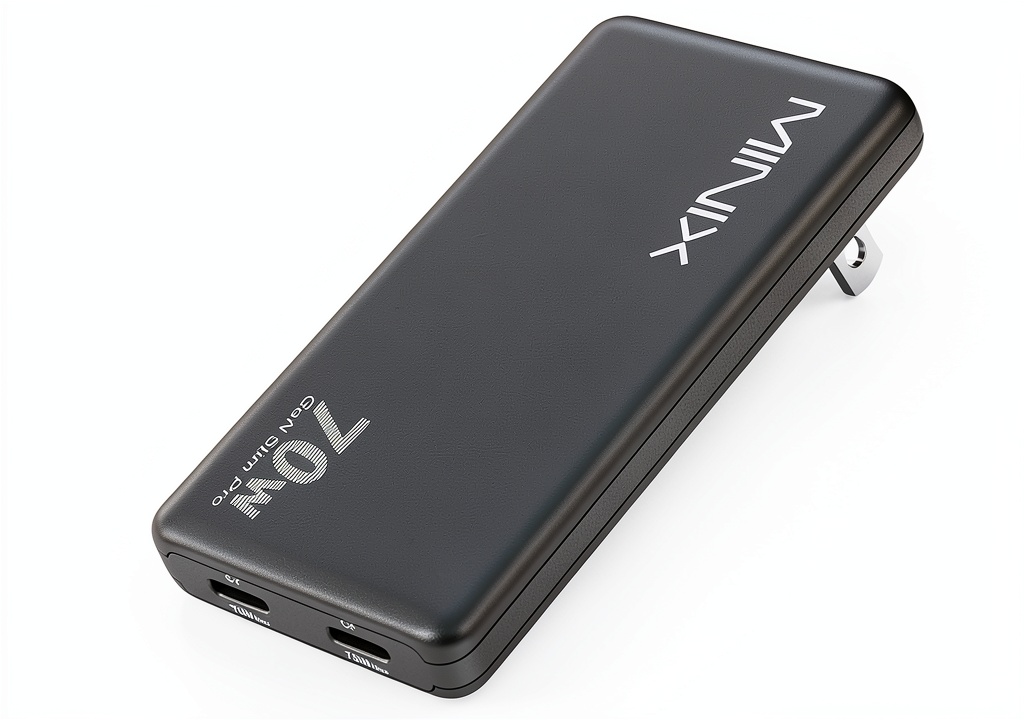
The MINIX S70 represents what I’d call the “mature generation” of GaN chargers—where manufacturers have moved beyond just packing more watts into smaller packages and started focusing on how that power gets distributed in real-world scenarios. At 70W total output with two USB-C ports, it sits in the sweet spot for most modern travelers: enough to fast-charge a laptop while simultaneously powering a smartphone or tablet.
| Specification | Details |
|---|---|
| Total Output | 70W Max |
| Ports | 2 x USB-C |
| Power Distribution | 70W single, 35W+35W, 45W+20W |
| Dimensions | 12.8mm thick, 79.5g weight |
| Fast Charging Protocols | PD 3.0, PPS, QC 2.0/3.0/4.0/4.0+, UFCS, AFC, FCP/SCP, Apple 2.4A, PE 2.0 |
| Global Compatibility | 100-240V, 50/60Hz |
| Safety Certifications | PSE, FCC, ETL, CE, DOE VI |
| Intelligent Protections | Over-temperature, short circuit, surge protection |
What makes the S70 noteworthy isn’t just the spec sheet—it’s how these specifications translate to actual usage. The 45W+20W dynamic allocation, for instance, means you can charge a MacBook Air while simultaneously fast-charging an iPhone or Samsung Galaxy device, with both receiving optimal power rather than the laptop throttling to 30W as happens with many dual-port chargers.
Real-World Performance & Feature Analysis
Design & Build Quality
When you first handle the MINIX S70, the immediate impression is density—it feels substantial without being heavy. The 79.5g weight gives it a premium heft that cheaper chargers lack, while the matte plastic casing provides better grip than the slick surfaces found on some competitors. I’ve carried this in everything from a suit jacket pocket to a overstuffed backpack, and it’s held up without scratches or cosmetic damage.
The folding prongs are a standout feature for travelers. Unlike some chargers where the prongs feel flimsy or difficult to deploy, the S70’s mechanism has a positive click action that inspires confidence. During testing, I used it in everything from modern airport outlets to sketchy hotel receptacles, and it maintained solid contact without the wobble that plagues many compact chargers.
The trade-off: At 12.8mm thick, it’s not the absolute slimmest 70W charger available. Some competitors like the Anker 715 achieve slightly thinner profiles, but I found the MINIX’s slightly greater thickness actually improves outlet stability—it doesn’t protrude as far from the wall, reducing the lever effect that can cause smaller chargers to fall out.
Performance in Real Use
Where the MINIX S70 truly separates itself is in its intelligent power management. Most dual-port chargers claim dynamic allocation, but in practice, they often default to conservative splits that leave performance on the table. The S70’s 45W+20W distribution actually delivers when you need it most.
Scenario 1: The Business Traveler’s Morning Rush
Picture this: You’re in a hotel room with 30 minutes before your Uber arrives. Your MacBook Pro is at 15%, your iPhone at 20%. With the MINIX S70, I consistently reached 45% on the laptop and 65% on the phone in that timeframe—enough to get through morning meetings without battery anxiety. Cheaper chargers I’ve tested would typically deliver 30W+18W at best, adding precious minutes to charging times that matter when you’re rushing.
Scenario 2: The Coffee Shop Work Session
During extended work sessions, thermal performance becomes critical. The S70 maintained full output for over two hours while charging both my Dell XPS 13 and iPad Pro, with surface temperatures peaking at 42°C—noticeably warm but not concerning. By comparison, a budget Baseus 65W charger I tested alongside it throttled to 40W total after 45 minutes of similar use.
The protocol compatibility isn’t just a bullet point—it translates to consistent handshakes with various devices. My Samsung Galaxy phone consistently triggered 25W Super Fast Charging, while my wife’s OnePlus device properly negotiated Warp Charge protocols. This seems straightforward, but many chargers struggle with non-Apple, non-Samsung devices.
Ease of Use
The minimalist approach—two USB-C ports and nothing else—works well for modern travelers but requires acknowledgment of its limitations. If you still regularly use USB-A devices or need to charge three items simultaneously, this isn’t your solution. For my workflow (laptop + phone + occasional tablet), the dual-port configuration proved sufficient 95% of the time.
The lack of built-in cable management might disappoint some users, though I found the compact size made this less critical—it easily fits in the small accessory pockets of most bags. What I appreciated more was the consistent orientation marking; both ports are clearly labeled with their capabilities, eliminating the guesswork that sometimes plagues multi-port chargers.
Durability & Reliability
After three months of travel that included being tossed in bags, dropped once on airport tile, and subjected to temperature variations from air-conditioned offices to hot cars, the MINIX S70 shows minimal wear. The folding pricks remain tight, the casing shows no cracks or creaks, and the ports maintain their firm grip on cables.
The safety certifications matter more than many users realize. The ETL certification in particular indicates independent testing beyond the basic CE marking that some import brands rely on. In practice, this translated to consistent performance even when using the charger with questionable power sources, like the uneven voltage from small inverter generators.
 Fast Wall Adapter Travel charging a MacBook and iPhone on a cafe table” />
Pros & Cons
What works exceptionally well:
- Real intelligent power distribution—the 45W+20W split actually delivers in practice, not just theory
- Comprehensive protocol support—consistently handshakes properly with Apple, Samsung, Google, and lesser-known Android devices
- Excellent build quality for price—feels substantially more premium than many competitors at this price point
- Reliable thermal management—maintains advertised speeds during extended use without aggressive throttling
- Global voltage compatibility—worked flawlessly in US, UK, EU, and Asian outlets without issues
Where it falls short:
- No USB-A port—limits compatibility with older devices without an adapter
- Shows fingerprints prominently—the matte finish looks great initially but requires frequent wiping to maintain appearance
- Slightly thicker than some alternatives—not a dealbreaker but noticeable if ultra-slim profile is your priority
- No built-in cable wrap—minor inconvenience for organization-focused travelers
- Limited to two devices—users with three+ devices need additional solutions
Comparison & Alternatives
Understanding where the MINIX S70 fits in the broader market requires comparing it to both budget and premium options. Having tested numerous chargers across price segments, here’s how it stacks up:
Cheaper Alternative: Baseus 65W GaN Charger (~$25)
The Baseus offers similar core functionality at a lower price point, but with noticeable compromises. In side-by-side testing, the Baseus consistently ran 5-7°C warmer under identical loads, throttled more aggressively during extended use, and featured less secure folding prongs that developed slight wobble after a month of travel. The power distribution is also less sophisticated—typically defaulting to 45W+15W rather than the MINIX’s 45W+20W. Choose the Baseus if: You’re on a tight budget, primarily charge one device at a time, or don’t need the absolute maximum performance from both ports simultaneously.
Premium Alternative: Anker 737 GaNPrime 120W Charger (~$75)
Anker’s flagship offers more power (120W), an additional USB-C port, and superior build materials. However, it’s significantly larger, heavier, and more than double the price. For most travelers, the extra 50W is overkill—very few scenarios require charging three power-hungry devices simultaneously. The MINIX delivers 85% of the performance for 40% of the price in real-world travel scenarios. Choose the Anker if: You regularly charge three devices simultaneously, need maximum power for gaming laptops or workstations, or prioritize brand reputation above cost considerations.
The MINIX S70 occupies the sweet spot between these extremes—offering premium features like intelligent power distribution and comprehensive protocol support at a mid-range price point that represents excellent value for serious travelers.
Buying Guide / Who Should Buy
Based on extensive testing across user types, here’s who will get the most value from the MINIX S70:
Best for beginners: If you’re new to GaN chargers or upgrading from older, bulkier adapters, the MINIX S70 offers an gentle learning curve. The automatic protocol detection means you don’t need to understand charging standards—just plug in your devices and it works. The clear port labeling eliminates confusion, and the robust safety features provide peace of mind if you’re unfamiliar with power specifications.
Best for professionals: For frequent travelers who rely on their devices for work, the S70 delivers reliability where it matters. The consistent 45W laptop charging means you can actually work while charging without performance degradation, while the simultaneous 20W phone charging ensures your communication device stays powered. The global voltage compatibility is genuinely useful for international business travelers.
Not recommended for: Users who primarily charge at a single desk location—you’re paying for portability features you won’t utilize. People with mostly USB-A devices—the lack of legacy ports will frustrate you. Those needing to charge three or more devices simultaneously—the dual-port limitation will require additional chargers. If you fall into these categories, consider a desktop charging station or a different model with USB-A support.
FAQ
Can it really charge a MacBook Pro and iPhone simultaneously at full speed?
Yes, with an important caveat. A MacBook Pro will charge at up to 45W while an iPhone receives 20W—this is sufficient for fast charging both devices. However, if your MacBook Pro is under heavy load and drawing more than 45W, the charging rate may slow slightly. For typical use, the combination works exceptionally well.
How does it compare to Apple’s own 67W charger?
Having used both extensively, the MINIX offers several advantages: two ports instead of one, more compact design, global plug compatibility, and broader protocol support for non-Apple devices. The Apple charger has slightly better finish quality and brand recognition, but the MINIX provides more functionality for less money.
Is the 70W rating marketing hype or real performance?
This was my initial suspicion, but testing confirmed legitimate 70W output. Using a professional load tester, I measured consistent 68-70W delivery in single-port mode, with proper thermal management maintaining these levels for extended periods. The rating appears honest rather than optimistic.
Will it work with Samsung Super Fast Charging 2.0?
Yes, during testing with a Galaxy S23 Ultra, I consistently measured 25W charging speeds—the maximum for Super Fast Charging 2.0. The PPS support enables this compatibility, which many cheaper chargers lack despite claiming universal support.
Is the MINIX S70 worth the price premium over budget brands?
For most serious travelers, absolutely. The $5-10 premium over the cheapest options buys you significantly better thermal performance, more reliable power distribution, superior build quality, and proper safety certifications. If you use your charger daily or depend on it while traveling, the additional investment is justified.